

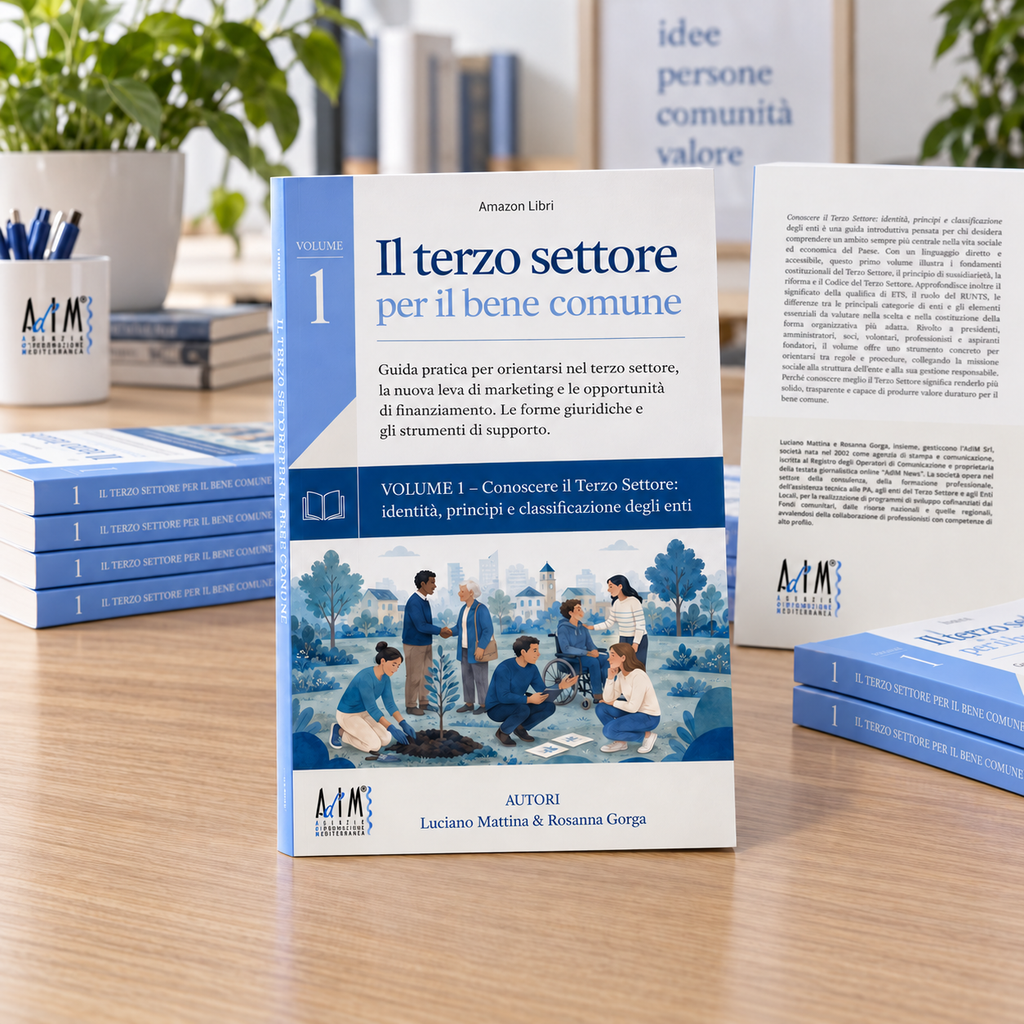
It is available from today, in paperback and ebook format, “Knowing the Third Sector: identity, principles and classification of entities", Of Luciano Mattina e Rosanna Gorga. With this publication, AdIM inaugurates the series “The Third Sector for the common good”: a journey in eight volumes that develops and updates the themes of the general guide published in 2020.
The project was born from the experience gained by AdIM in training, in information and working alongside social realities. In comparison with associations, cooperatives and professionals often have a common need: be able to count on clear references to orient yourself between regulations, organizational obligations and choices, understanding how these impact the activities and purposes of the entities.
The series responds to this need with accessible language: the goal is to bring knowledge closer to practice, offering useful tools to deal with the daily responsibilities of those who work in the Third Sector with greater awareness.
Starting from the foundations to build solid projects
The first volume addresses the questions that precede every organizational choice: what is meant by Third Sector? What relationship does it have with the public administration and with the market? What distinguishes a non-profit organization from a third sector organisation?
These are essential questions for anyone who intends to start a social initiative, but also for those who already manage an organization and want to better understand its identity and functioning. The book clarifies, in particular, so that the absence of profit-making purposes is compatible with the carrying out of economic activities, the production of revenues and the employment of workers. It thus accompanies the reader in understanding the relationship between social mission, activities of general interest and prohibition on the distribution of profits.
This reflection is accompanied by an in-depth study of the constitutional principle of subsidiarity and citizen participation: two fundamental references for understanding the contribution of the Third Sector to the life of communities and the care of the common good.
Understand the reform and recognize the different types of institutions
The volume reconstructs the framework of the reform, illustrating the Third Sector Code, the role of the Single National Register of the Third Sector (RUNTS) and the elements that characterize the system. The reader is then accompanied in learning about the main categories of entities: voluntary organizations, social promotion associations, philanthropic organizations, social enterprises and social cooperatives, mutual aid society, association networks and other ETS.
Understanding these differences helps link a project's goals to the most appropriate organizational form, evaluating with greater awareness the characteristics and responsibilities that each entails.
From the idea to the establishment of the institution
The last part of the book deals with the formation process and the main aspects of the functioning of an institution. Memorandum of association and statute, organi, legal personality and registration to RUNTS are discussed together with the topics of volunteer participation, of the employment of workers, of the administrative organization and post-establishment obligations. The path relates initial choices to daily management. Clearly define purpose, roles and rules in fact mean creating the conditions to give continuity to activities and support the social mission over time.
The volume is aimed at those who wish to set up an entity, to those who already work in an organization and to whom, for study or profession, wants to approach the Third Sector through an organic and understandable framework.
Knowing the Third Sector better means managing it with greater responsibility and putting skills at the service of the community. The AdIM editorial project starts from this belief, of which the first volume represents the starting point.
“Knowing the Third Sector: identity, principles and classification of entities” is now available in paper and ebook format.
🛒 Buy the book: [LINK ALL’ PURCHASE]