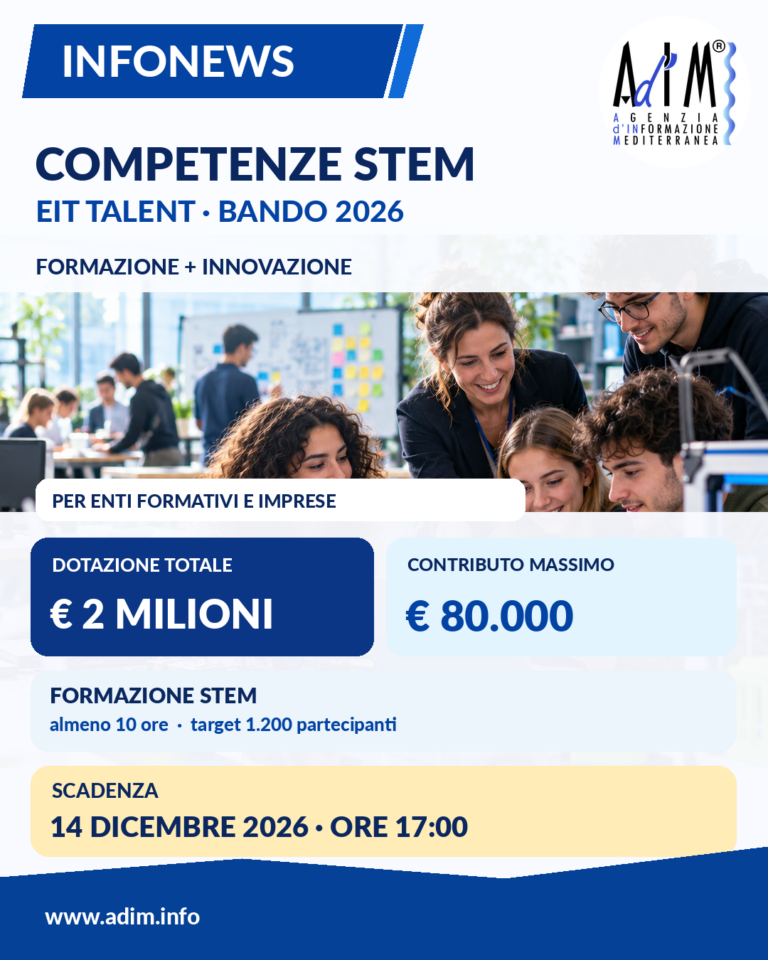


Expiration: 14 December 2026, ore 17:00 CET
Goals: The EIT STEM Tech Talent Induction 2026 – Building Future-Ready STEM Talent supports training courses that bring students and adults closer to scientific skills, technological, engineering and mathematics (STEM). The initiative, funded by the European Institute of Innovation and Technology (EIT) and managed by 28 DIGITAL, strengthens the link between education, professional training and business needs.
What to finance: The European call finances introduction activities, STEM orientation and training, designed with the productive world and capable of facilitating the continuation of studies, access to specialist training and entry into work. Replicable models are expected, inclusive and consistent with verifiable territorial and sectoral needs.
STEM fields:
natural sciences, mathematics and statistics (ISCED 05);
information and communication technologies (ISCED 06);
engineering, manufacturing and construction (ISCED 07).
Interdisciplinary approaches with an effective STEM component are permitted, also related to space technologies, artificial intelligence and digital innovation.
- Training activities: modular introductory courses, orientation paths for students and workers, challenges proposed by businesses, local STEM laboratories, hackathon, simulations, online forms and retraining initiatives. The methodologies can be in presence, online o lose, as long as they support active learning.
- Duration of the routes: each course must include at least 10 hours of structured learning, with clear training objectives, appropriate practical components, competence evaluation criteria and EIT quality standards. Isolated events without a real educational path are not sufficient.
- Final recipients: people interested in continuing their studies, STEM education or careers; priority to educational levels ISCED 3–5 and VET/VET pathways. They are also considered college students, adults in career transition and underrepresented groups, in compliance with the conditions of the call.
Expected results: each proposal must include a realistic objective of at least 1.200 trained participants and demonstrate how the route can be reused and expanded. The program also aims to encourage the involvement of women and girls and participants from Regional Innovation Scheme countries (RIS).
Inclusion: at the initiative level, involvement objectives are indicated 40% of women and girls and of 30% of participants from RIS countries; proposers must describe outreach actions, accessibility and participation measures consistent with its targets.
Methodology: the proposal must connect concrete needs of businesses, curriculum, learning outcomes, evaluation and opportunities for continuation towards training or employment paths. The collaboration with the production sector must be documented and have an effective role in the design.
- Duration of projects: indicative start date 1st April 2027 and conclusion by 31 December 2027. Planning includes design and development, subsequently disbursement, validation and monitoring of courses and results.
- Quality and monitoring: the selected projects must adopt the EIT STEM Competence Framework, the pedagogical standards and quality controls required. Verifiable participant data is required, on the activities provided, on results and use of resources.
- Strategic coherence: particular importance is attributed to the skills required by the industry, to applied learning, the participation of underrepresented groups and the possibility of extending training methodologies over time.
- the nominations will be evaluated based on excellence, impact, quality and efficiency of implementation and strategic coherence with EIT STEM objectives.
- who can participate: consortia of legal entities eligible according to Horizon Europe can compete, compulsorily including at least one education or training body and at least one partner from the business or industrial world. Membership in the 28DIGITAL network is not required.
- Training organisations: schools, university, organism e reti VET, Training Bodies, associations and NGOs operating in STEM learning, EdTech subjects, technological academies, networks of educators and other providers consistent with the aim of the initiative.
- Economic-productive partners: businesses, PMI, startup, scaleup, industrial associations, cluster, hub for innovation, Research centers, incubators and other organizations with a demonstrable role in the STEM and innovation ecosystem.
- Partnership: at least two complementary components are necessary, one educational and one entrepreneurial. Public or territorial actors and collaborations between regions or countries are encouraged, if justified by the project strategy.
- Geographic eligibility: entities established in EU member states can be financed, in countries associated with Horizon Europe and in other territories expressly eligible under the call. Other subjects can participate under the established conditions, also as associated partners without financing.
- The application must explain the role of each partner, the distribution of activities, the skills available, the recruitment of learners and the sustainability of the model after funding.
- It is advisable to check the PIC code in the preparatory phase, the eligibility conditions of organizations, data protection obligations, the possible use of AI tools and the documentary requirements in English.
Financing body: European Institute of Innovation and Technology (EIT), as part of the EIT STEM Tech Talent Induction initiative; operational management of the call entrusted to 28DIGITAL.
Participation in the call by legal entities does not automatically imply eligibility to receive contributions: location and funding requirements must be verified for each beneficiary.
Eligible expenses: the support is recognized as reimbursement of the costs actually incurred and reported, within the limits of the approved budget and Horizon Europe/EIT rules. Personal categories are foreseen, subcontracts, travel and stays, equipment, other goods and services and indirect costs.
Indirect costs: the flat rate indicated is 25% of eligible direct costs, with the exclusions provided for in the notice, including subcontracts and other non-computable categories. It should not be confused with a contribution from 25% to the project.
- Budget and activities: expenses must be attributed to the correct activities and partners; realistic estimates are required, verifiable justifications and adequate accounting documentation. Expenses cannot exceed the approved reporting budget.
- Delivery: Four indicative tranches of EIT financing are envisaged: 30%, 20%, 20% and balance 30%, subordinate to the approval of deliverables and reports. Payment dates may extend to 2028 according to contractual agreements.
- Submission of the application: the organization must register on the EU Funding portal & Tenders to acquire or verify the Participant Identification Code (PIC) and then submit the proposal in English via the 28DIGITAL application system.
- Proposals must be complete with all fields, of mandatory documents and technical information, operational and economic requirements. An incomplete application or one sent after the deadline is inadmissible.
Amounts: EIT total budget up to 2.000.000 euro, with an indicative maximum contribution of 80.000 euros per project and up to 25 projectable projects. The contribution is a reimbursement of actual documented costs; the call does not have a single minimum amount guaranteed for each proposal.