

Press release is received and published
From the analysis of the jurist Adriano J. Spagnuolo Vigorita and the lawyer. Riccardo Vizzino (Civics) an initiative to collect reports is born to protect citizens and healthcare professionals also through collective actions.
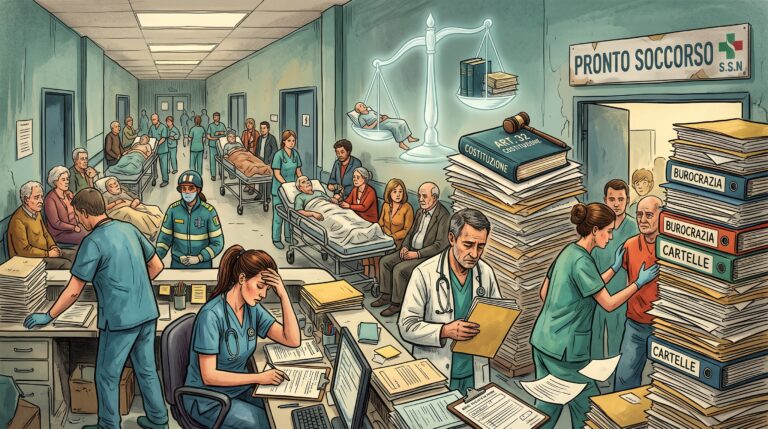
The public debate on Italian healthcare focuses almost exclusively on individual episodes of “bad luck”, attributing the main cause of adverse events to the doctor's or nurse's error, but the real emergency of Italian hospitals today lies in the structural malorganization of the system. As enshrined in the Gelli-Bianco Law (L. n. 24/2017) and by the jurisprudence of legitimacy (Cass., Sez. Unite, n. 577/2008), the safety of care is an integral part of the right to health pursuant to art. 32 of the Constitution and imposes on healthcare facilities the obligation to provide an efficient and safe organization.
From the analysis of systemic critical issues, five main issues emerge that compromise the good performance of the Public Administration (art. 97 Cost.) and the dignity of the person (articles. 2 e 32 Cost.):
- Staff shortages and clinical risk: Years of turnover freezes and spending cuts have imposed heavy shifts and understaffed work, causing prolonged waits on stretchers in emergency rooms for the most fragile patients and an increase in pressure sores and nosocomial infections. On the domestic front, burnout, stress and aggression fuel the flight of qualified doctors and nurses towards the private sector or abroad.
- Role confusion, demotion and disciplinary abuse: Staff shortages lead to inappropriate overlapping of nurses' duties (D.M. 739/1994, L. 42/1999, L. 251/2000) and those of Social and Health Workers (State-Regions Agreement 22/02/2001), also in the logistical management of patients “in support” in other departments. This demotion violates the art. 2103 c.c. and generates compensable professional and existential-relational damage (Cass. ord. n. 23183/2022; Cass. sent. n. 32359/2025), while there are general disciplinary complaints in violation of the art. 7 of the L. n. 300/1970 and gaps in nursing records that exacerbate clinical and judicial risk (Cass. nn. 6209/2016 e 29001/2018).
- The emptiness of post-hospitalization and the absence of psychological support: Despite the regulatory provisions on hospital-territory continuity (D.Lgs. n. 502/1992, D.P.C.M. 12/01/2017 e D.M. n. 77/2022), the resignation of elderly people, non-self-sufficient or stoma sufferers often translate into improper delegation to families and caregivers without specific training, to which is added the chronic lack of psychological assistance for cancer and chronic patients.
- Waiting lists and double-speed healthcare: The incompatible times of services in the public channel compared to the speed of the private or intra-moenic ones create inequalities based on economic capacity, undermining the universality of the National Health Service (articles. 3 e 32 Cost.) and pushing many citizens to give up treatment.
- Public costs and revenue damage profiles: The set of medico-legal disputes (including preventive technical checks pursuant to art. 696-bus c.p.c.), of labor causes, avoidable rehospitalizations and management inefficiencies weigh heavily on public budgets, configuring possible profiles of administrative and accounting responsibility before the Court of Auditors pursuant to art. 103 Cost..
The call for participation and contacts for reporting
To transform the complaint into preventive and effective protection, the authors of the document — Adriano J. Spanish Vigorita (Jurist and essayist) and l’Lawyer. Riccardo Vizzino (Court of Cassation expert and national manager of Civicazia against scams) — invite patients, family members, caregiver, medici, nurses and OSS to report and document their experiences by writing to the e-mail address info@studiolegalevizzino.it. The reports collected and verified will form the basis for institutional discussions, awareness campaigns and possible legal action, also collective, including the appeal for the efficiency of public administrations provided for by the Legislative Decree. n. 198/2009.