

The new edition is already a reality, but the transition does not happen overnight. A transition phase full of deadlines opens for organizations and auditors, updating of skills e, above all, of a good opportunity to revisit the environmental system with new eyes.
When such a widespread norm changes, the first question is almost always practical: what happens to the certificate we already have? The answer, in the case of ISO 14001:2026, it's reassuring. The publication of the new edition, took place the 15 April 2026, did not cancel the certifications issued according to ISO overnight 14001:2015. Instead, a transition period has opened, designed specifically to allow organizations to adapt without disruption and certification bodies to qualify people, procedures and processes.
Dates to remember
The most important distinction is this: the ISO 14001:2026 it is already the current version of the standard, while the certifications according to the edition 2015 they can continue to live for a limited period. In the framework communicated by Accredia for the Italian accredited system, the transition period lasts three years and ends on 30 April 2029. By that date all certified organizations must have completed the transition to the new edition; after the deadline, ISO certificates 14001:2015 they will no longer be valid.
Then there is a second important deadline. Spent 18 months from the last day of the month of publication, so from 30 October 2027, new ISO certificates can no longer be issued 14001:2015. In practice, those entering the certification process for the first time will have to be progressively directed towards the version 2026; those who are already certified will be able to upgrade during a surveillance audit, renewal or through a dedicated transition audit. ISO itself reminds that the transition normally takes place during the certification cycle, generally within about three years.
This means that there is no need to run in a disorderly manner, but it would be a mistake to wait until the last moment. Three years seems like a long time until you consider that a serious environmental system involves contextual analysis, environmental aspects, compliance obligations, risks and opportunities, goals, suppliers, operational controls, emergencies, monitoring and audits. The best transition is one that enters the normal rhythm of the organization.
It's not enough to update documents: skills must grow
The review also concerns people. Internal environmental managers should update their knowledge of the standard with a targeted path on the differences between 2015 e 2026 and translate the new requirements into your context. There is no universal number of hours imposed on all company managers: what matters is being able to demonstrate adequate competence for the role. In concreto, the upgrade should include at least the new way of reading context and environmental conditions, climate change, biodiversity and resource availability, life cycle perspective, processes and services provided externally, change management and new expectations on performance measurement.
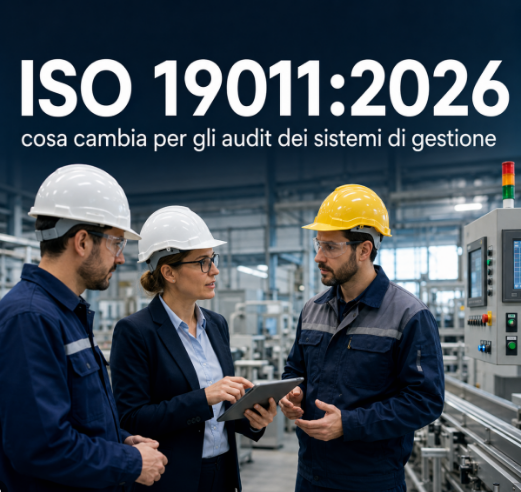
For first and second party auditors the issue is even more evident. In May 2026 the new ISO has also been published 19011:2026, the international guideline for management system audits. It's a useful coincidence: those who conduct internal audits or supplier audits can capture the transition to 14001 as an opportunity to update technical environmental skills and audit methods together. It is not enough to know the number of the new paragraph: you need to know how to transform a requirement into effective questions, look for consistent evidence, read the real environmental risks and evaluate whether the system produces results, not just documents.
For third party auditors, that is, those who work for certification bodies, the level of formalization is naturally higher. Date ISO/IEC 17021-2, which defines the specific competence requirements for audits and certification of environmental systems, remains the current technical reference. Accredia has also provided that certification bodies include the training and qualification of the personnel involved in their transition plans and provide evidence of updated skills. Those with external professional qualifications will also need to comply with the rules of their scheme: for example, IRCA has a mandatory transition module for its certified EMS auditors.
One step to use, not to be suffered
The temptation, in every change of edition, is to look for a table of differences, correct some procedures and get to the audit. That would be the easiest way to lose the value of the review. The real advantage lies in doing a good gap analysis and asking yourself not just "what is missing?”, but “what can we finally make better?”. An environmental register can become more relevant to real risks; supplier evaluation may include more mature environmental criteria; goals can be better linked to data; management can use the system to make more informed decisions.
This is the positive part of the transition. A certificate 2015 it doesn't suddenly become useless and no one is forced to start from scratch. The built experience remains. Change the level of attention required. The new ISO 14001 offers three years to transform a training obligation into an investment in skills, organization and credibility. Whoever uses this time well will arrive at 2029 not just with a new certificate, but with an environmental system closer to reality and more capable of accompanying the future.
RPL
Sources and references: ISO, ISO 14001:2026 and official transition guide. | Accredit, DC Circular No. 14/2026 on the transition to ISO 14001:2026 and note of 29 maggio 2026. | ISO, ISO 19011:2026. | ISO/IEC 17021-2:2016, confirmed in 2026. | CQI/IRCA, transition requirements for EMS ISO auditors 14001:2026.